
A good filing checklist should make the next read calmer and faster, not turn the document into a box-ticking exercise. Many investors know they should be more systematic with filings but never settle on a process they can actually repeat. A useful checklist solves that problem without becoming bureaucratic.
A checklist matters because it reduces random reading. Instead of drifting through the filing, you start with a question, a few proof sections, and a clearer sense of what the document needs to confirm. The goal is not to read more words than necessary. It is to read the right part of the filing in the right order.
- A checklist should make the next filing easier to read, not harder.
- Different filing types deserve different versions of the checklist.
- The best checklist ends with a verification note, not a false sense of certainty.
Why this matters
A checklist matters because it reduces random reading. Instead of drifting through the filing, you start with a question, a few proof sections, and a clearer sense of what the document needs to confirm.
The checklist should fit the job. A 10-K needs a longer business and risk pass. A 10-Q needs a change-detection pass. An 8-K needs an event-and-impact pass.
What to look for
The checklist should fit the job. A 10-K needs a longer business and risk pass. A 10-Q needs a change-detection pass. An 8-K needs an event-and-impact pass.
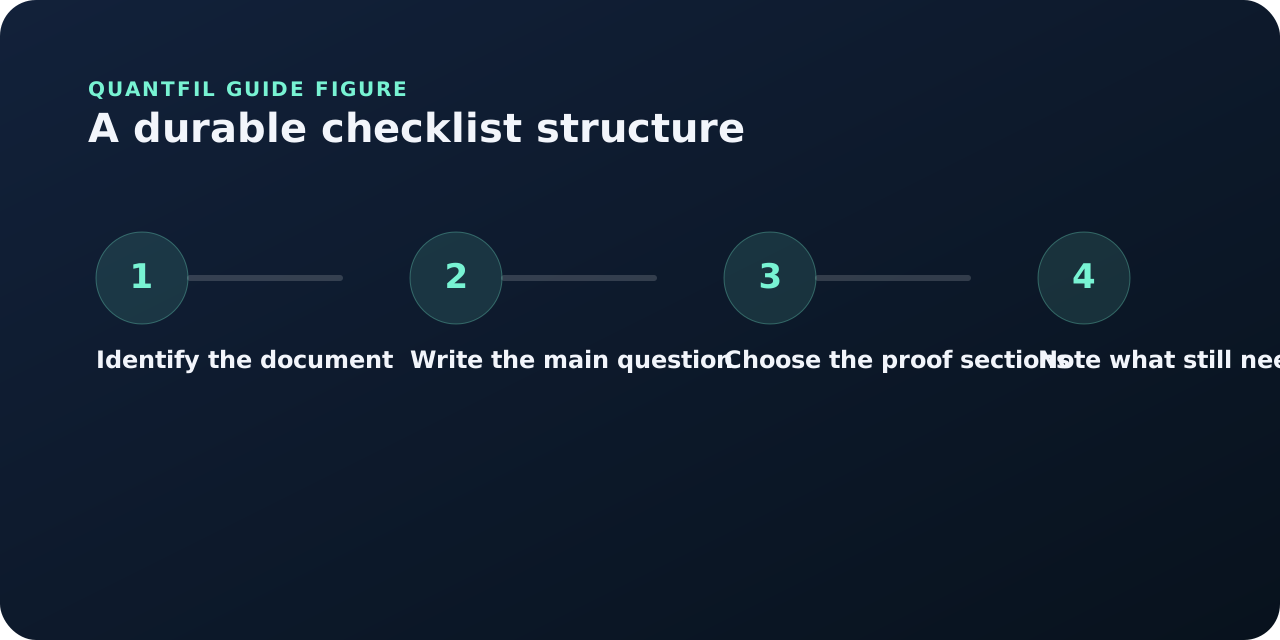
Build the checklist around document type, main question, proof sections, and verification notes. That is usually enough structure to make the read better without making it rigid.
- Start with the filing type.
- Write the one question the document should answer.
- Choose the sections most likely to prove or challenge the answer.
- Leave room for what still needs source verification.
A practical workflow
Build the checklist around document type, main question, proof sections, and verification notes. That is usually enough structure to make the read better without making it rigid.
That workflow becomes easier to repeat when you write the next question down before moving on. The filing should not just be read. It should leave you with a sharper question than you had at the start.
Common mistakes
The common mistake is building a checklist that is too long to use under real conditions. Another is making one checklist serve every filing type equally badly.
A slower, more selective filing habit usually beats a faster but less structured one. In most cases the difference comes from knowing what you are trying to prove before you go hunting through the document.
How to use this on Quantfil
Quantfil works well with checklists because the site already groups the summary, the comparison, and the statement sections into a reading order many investors can reuse.
Quantfil is most useful when the educational question comes first and the company page comes second. Learn the document, then use the filing page to apply that reading habit to a real report.
Try it on Quantfil
Move from the educational overview into live filing pages that show summaries, comparison cards, and source-linked context.
Frequently asked questions
Should one checklist work for every filing?
Usually no. A 10-K, 10-Q, and 8-K often need different emphasis.
How long should a checklist be?
Short enough to use consistently. If it becomes a burden, it stops helping.
What should every checklist include?
The filing type, the main question, the proof sections, and a note on what still needs verification are good basics.
How does Quantfil help?
It already organizes many of the sections a practical checklist would point you toward.
Primary sources and further reading
Editorial note and disclosure
Quantfil publishes these guides for informational purposes only. They are designed to help readers understand filing structure, investor workflow, and source verification, not to offer investment advice or security recommendations.
If a guide looks stale, unclear, or incomplete, use the source links above and review our editorial standards, corrections policy, and editorial team page for how the site handles updates and accountability.