
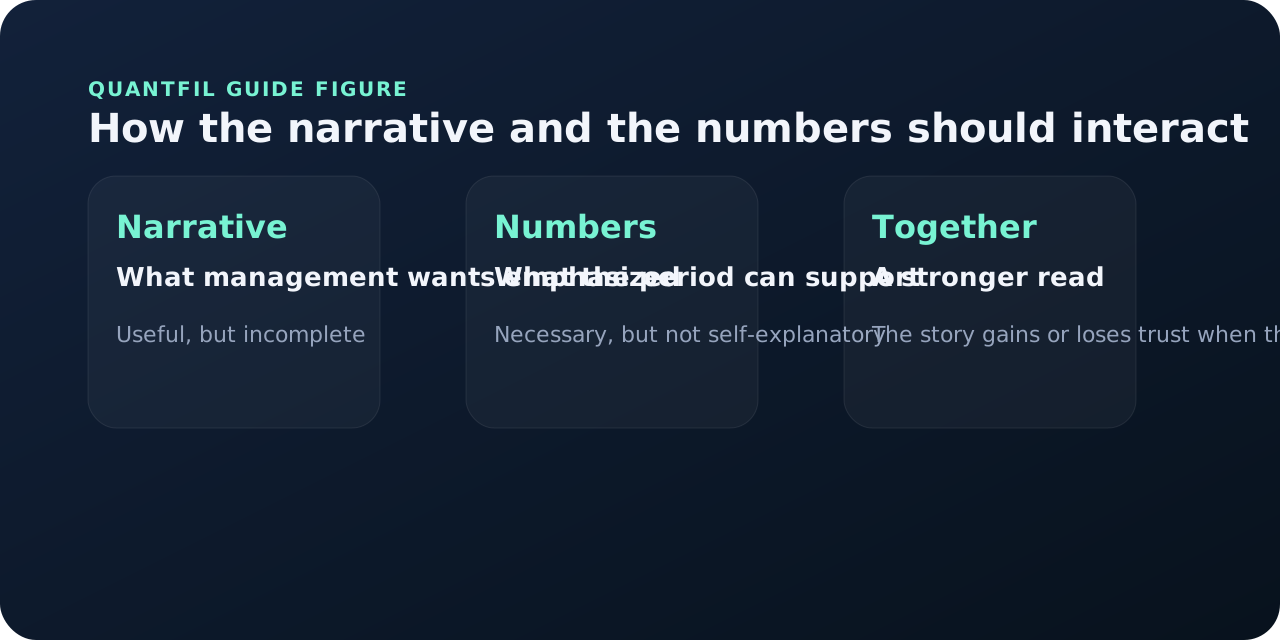
The useful habit is not to pick a side between story and math. It is to understand that every filing contains both. The narrative tells you what management wants emphasized. The numbers tell you whether the story has enough weight behind it. A lot of filing mistakes happen because investors lean too far toward one side. Some trust the story too quickly. Others distrust management so completely that they miss useful framing. Both habits can be weak.
This matters because filings are not raw data dumps. They are structured documents where management explains what happened, what mattered, and what should be watched next. The right mental model uses that explanation as an input, not as a conclusion. The goal is not to read more words than necessary. It is to read the right part of the filing in the right order.
- Narrative and numbers are both useful, but neither is complete alone.
- The filing becomes strongest when the story and the evidence reinforce each other.
- The cleanest next question often comes from the gap between the two.
Why this matters
This matters because filings are not raw data dumps. They are structured documents where management explains what happened, what mattered, and what should be watched next. The right mental model uses that explanation as an input, not as a conclusion.
Look for the main narrative claim, the statement lines that should support it, the note or risk disclosure that could qualify it, and the comparison with the prior filing that shows whether the same story is becoming more or less credible.
What to look for
Look for the main narrative claim, the statement lines that should support it, the note or risk disclosure that could qualify it, and the comparison with the prior filing that shows whether the same story is becoming more or less credible.
Use the narrative to identify the company's preferred explanation, then use the numbers and notes to decide whether the explanation is clean, partial, or weak.
- Write down the main narrative claim from the filing or earnings materials.
- Choose the statement lines that should support it.
- Find the note or risk disclosure most likely to qualify it.
- Decide whether the narrative deserves full trust, partial trust, or caution.
A practical workflow
Use the narrative to identify the company's preferred explanation, then use the numbers and notes to decide whether the explanation is clean, partial, or weak.
That workflow becomes easier to repeat when you write the next question down before moving on. The filing should not just be read. It should leave you with a sharper question than you had at the start.
Common mistakes
The common mistake is to confuse management confidence with business quality or, on the other side, to ignore narrative framing entirely and miss what the filing is really trying to get you to believe.
A slower, more selective filing habit usually beats a faster but less structured one. In most cases the difference comes from knowing what you are trying to prove before you go hunting through the document.
How to use this on Quantfil
Quantfil is built around this mental model. The summary gives the narrative read, the comparison cards and statements test it, and the source link lets the reader verify the harder edges.
Quantfil is most useful when the educational question comes first and the company page comes second. Learn the document, then use the filing page to apply that reading habit to a real report.
Ask yourself
Try it on Quantfil
Move from the educational overview into live filing pages that show summaries, comparison cards, and source-linked context.
Try the next workflow
Use one of these next-step pages if you want to turn the concept into a repeatable habit on a live filing, earnings setup, or company comparison task.
Frequently asked questions
Should investors distrust management by default?
Not by default. The better habit is to verify management rather than either trust or dismiss the narrative automatically.
Can the numbers mislead too?
Yes. Numbers without context can still produce weak interpretations. The point is to compare the two, not to worship one side.
What does a good filing read produce?
Usually a clearer hierarchy of what is proven, what is promising, and what still needs evidence.
How does Quantfil help?
It helps put the narrative and the statement proof close enough together that the comparison becomes easier to make.
Primary sources and further reading
Editorial note and disclosure
Quantfil publishes these guides for informational purposes only. They are designed to help readers understand filing structure, investor workflow, and source verification, not to offer investment advice or security recommendations.
If a guide looks stale, unclear, or incomplete, use the source links above and review our editorial standards, corrections policy, and editorial team page for how the site handles updates and accountability.