
A 10-Q is the quarterly SEC filing that shows how the company’s business and financial statements have changed since the prior quarter and the prior-year quarter. It is not as comprehensive as a 10-K, but it is often more useful for tracking direction because it captures the parts of the business that are actively changing.
For a mixed audience, the simplest way to think about the 10-Q is this: the 10-K tells you the full-year business story, while the 10-Q tells you whether that story is getting better, worse, or more complicated. It is the filing investors use to spot acceleration, slowdown, margin pressure, working-capital shifts, and changes in management tone before the next annual report.
- A 10-Q is the quarterly SEC filing that updates the company’s operating and financial picture.
- It is especially useful for change detection across revenue, margins, cash flow, and working capital.
- Use the 10-Q to compare current quarter versus prior quarter and prior year, not just to read the headline numbers.
Why investors care about 10-Q filings
Quarterly filings matter because public companies do not change only once a year. Demand can soften, margins can compress, inventories can build, receivables can stretch, and capital spending can accelerate within a single quarter. The 10-Q is where those shifts start to show up in a formal, comparable way.
That makes the filing useful for both beginners and advanced readers. Beginners get a structured place to learn what changed. More experienced investors get a disciplined update that is less filtered than a market summary. The value of the 10-Q is not that it replaces the annual filing. It is that it gives you a recurring checkpoint on the health and direction of the business.
What is usually inside a 10-Q
A 10-Q includes management discussion, quarterly financial statements, selected notes, controls disclosures, and any risk-factor updates if something meaningful changed. It usually gives you enough to understand the quarter even though it does not repeat the entire full-year business description from the 10-K.
That is important because many of the most useful quarterly signals live in the combination of narrative and numbers. You want to see how management explains the quarter, then verify whether revenue, margin, cash flow, inventory, receivables, and balance-sheet movement support that explanation. The 10-Q is shorter than the 10-K, but it is not lighter on signal.
Best questions to ask when reading a 10-Q
The first question is whether the quarter changed the trajectory of the business or merely changed the headline. Did revenue improve because demand actually strengthened, or because mix and timing helped? Did margins improve because the business got better, or because a temporary cost or pricing effect flattered the period? Did cash flow confirm the result, or did it lag behind earnings?
The second question is whether the quarter changes what should be watched next. That could mean inventory pressure, higher capital spending, customer concentration, pricing sensitivity, or a more cautious tone from management. A strong 10-Q read is not just retrospective. It narrows the list of forward questions that matter.
- Did revenue, operating income, EPS, and operating cash flow move in the same direction?
- Did management update any risks or emphasize a new pressure point?
- Does the quarter look stronger against the prior quarter, the prior year, or neither?
How to use a 10-Q on Quantfil
Quantfil is especially useful on 10-Q pages because the platform is built around comparison. The biggest advantage of a quarterly filing summary is that it helps you see the quarter in relation to the prior report. That is where signal usually lives. A good read should tell you whether the filing improved the business case, weakened it, or simply kept the same debate alive.
For example, you can open Tesla’s or Microsoft’s filing summary on Quantfil, inspect the comparison cards and statement sections, and then decide whether the quarter deserves a deeper source review. That is often a much better workflow than reading a quarterly headline and assuming the quarter was clean.
Common 10-Q mistakes
One common mistake is reading a 10-Q as if it were a smaller 10-K. The 10-Q is not primarily about re-learning the whole business. It is about learning what changed. Another mistake is anchoring too heavily on EPS or revenue without checking whether operating income, cash generation, and working capital tell the same story.
A final mistake is assuming a quarter is meaningful because it moved the stock. Market reaction can be useful context, but the filing itself is what tells you whether the move was supported by the business. The more mixed the statement picture is, the more cautious the read should be.
Try it on Quantfil
Move from the educational overview into live filing pages that show summaries, comparison cards, and source-linked context.
Frequently asked questions
How many 10-Qs does a company file each year?
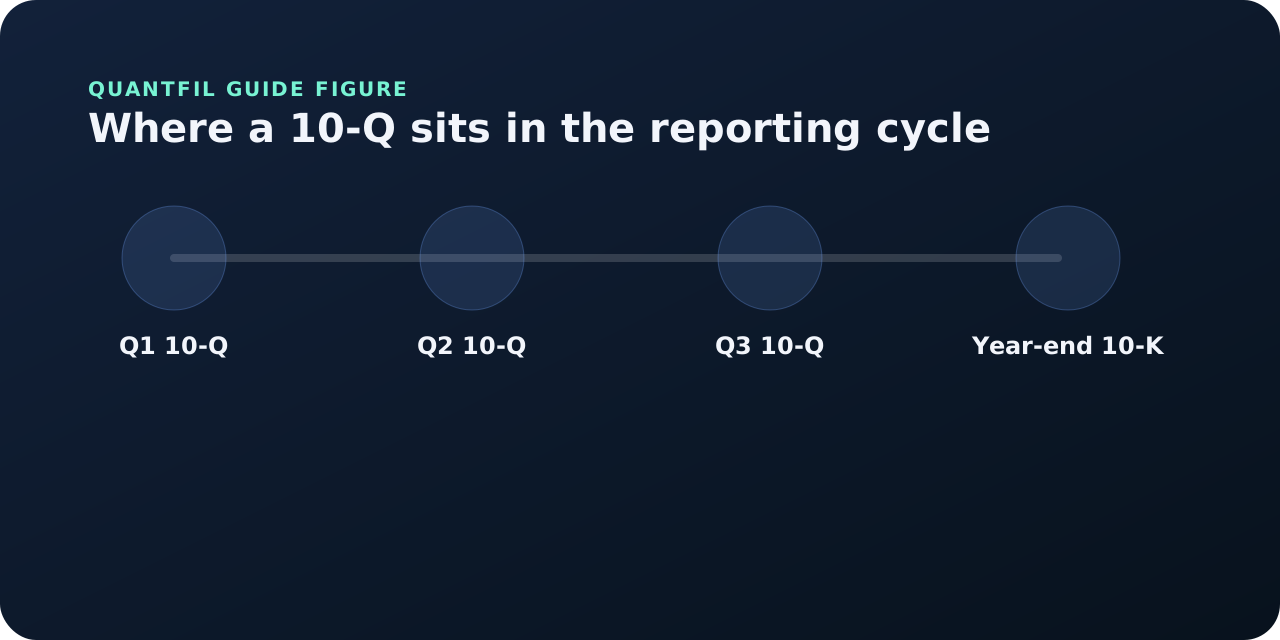
Most U.S. public companies file three 10-Qs for the first three fiscal quarters and then file a 10-K for the full year.
Is a 10-Q audited like a 10-K?
Quarterly statements are typically reviewed rather than audited in the same way as the annual 10-K financial statements.
What is the quickest way to use a 10-Q well?
Compare the latest quarter with the prior quarter and prior year, then check whether cash flow and margins support the headline.
Should I read a 10-Q if I already read the earnings release?
Yes. The filing is usually more useful because it provides a fuller statement and disclosure update.
Primary sources and further reading
Editorial note and disclosure
Quantfil publishes these guides for informational purposes only. They are designed to help readers understand filing structure, investor workflow, and source verification, not to offer investment advice or security recommendations.
If a guide looks stale, unclear, or incomplete, use the source links above and review our editorial standards, corrections policy, and editorial team page for how the site handles updates and accountability.