
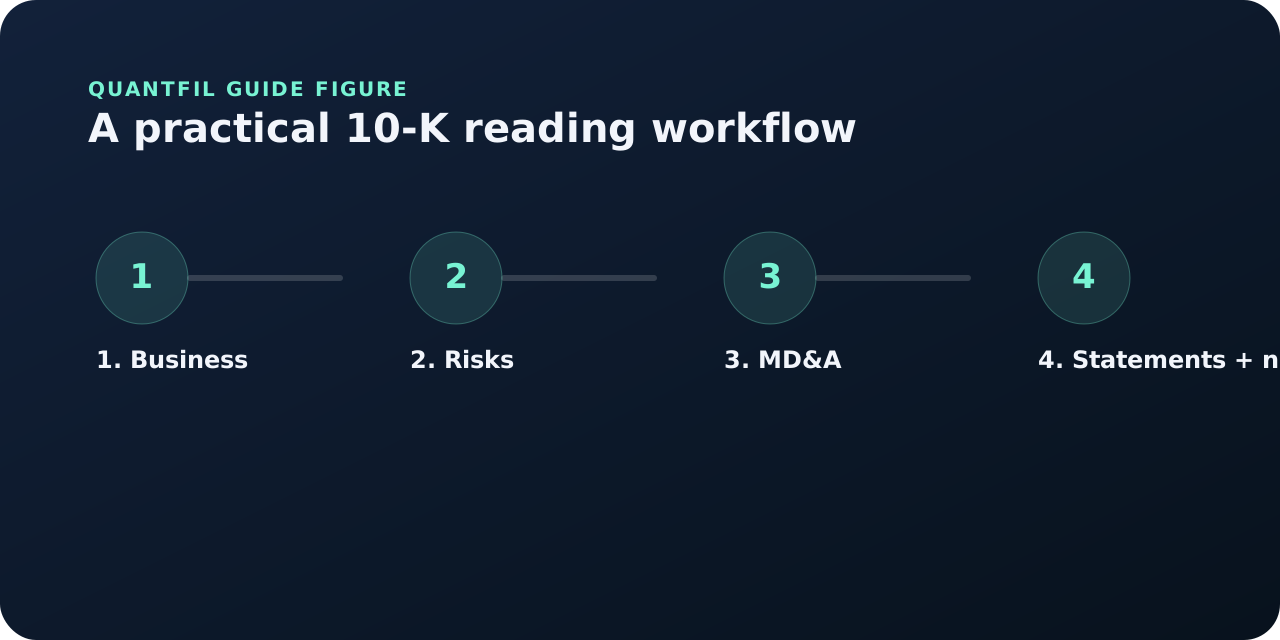
A strong 10-K workflow is built to save time, not consume it. If you open an annual filing and start reading at page one without a plan, you usually end up with more text than insight. The better approach is to move through the filing in a sequence that helps you understand the business first, then the risks, then management’s explanation, and finally the financial proof.
That structure helps both beginners and experienced investors. Beginners need orientation. Experienced investors need speed without losing rigor. The workflow below is meant to serve both. It does not ask you to memorize every SEC item. It asks you to learn what each section is for and how to tell whether the filing changed the underlying business read.
- Read a 10-K in layers: business, risks, MD&A, statements, then notes.
- Use the filing to answer what changed, how durable it looks, and what still needs verification.
- Quantfil is most useful before the deep read, because it helps you decide which filing deserves more time.
Start with the business, not the numbers
The Business section tells you what the company actually does. That sounds obvious, but it is where many investors skip too quickly. Before you decide whether margins are attractive or cash flow is strong, you need a mental model of how the company makes money, which segments matter, and how the industry works. Without that, the rest of the filing becomes a collection of numbers without context.
When reading this section, look for revenue drivers, segment structure, customer concentration, geography, regulation, and operating leverage. Ask whether the business is simple or structurally messy. Ask whether the company depends on one product line, one buyer group, or one demand cycle. Those answers shape how you should interpret everything that follows.
Read Risk Factors before you decide the story is clean
Risk Factors matter because they often contain the most honest constraints in the filing. This is where management has to say what could impair results, compress margins, increase volatility, or change the trajectory of the business. A company may sound strong in summaries, but the risk section often reveals where management sees fragility.
Do not read this section looking only for dramatic language. Read it looking for specificity and change. Has a familiar risk become more detailed? Has a new one appeared? Has the company shifted emphasis from demand to regulation, from supply chain to competition, or from liquidity to technology execution? Those changes often matter more than the existence of risk itself.
Use MD&A to understand management's framing
MD&A is where management explains what it thinks drove results. It is one of the most useful sections because it translates the year into management’s own logic. The question is not whether management sounds optimistic. The question is whether its explanation is specific, balanced, and consistent with the statements.
When reading MD&A, look for how the company explains revenue, margin, cash flow, capital spending, and liquidity. Ask whether the language emphasizes mix, demand, pricing, cost discipline, or one-time factors. Then compare that explanation with the financial statements. If the wording and the numbers line up, confidence improves. If they diverge, that is where the deeper work should happen.
Verify the story in the statements and footnotes
Once you understand the business and management’s framing, the statements become far more useful. The income statement shows whether revenue and operating income moved together. The cash flow statement shows whether earnings translated into cash. The balance sheet shows whether the company is getting more resilient or more stretched.
Do not stop at the face of the statements. The notes are often where stock compensation, acquisition effects, debt terms, lease commitments, segment detail, and accounting judgments become clear. That is why a good 10-K workflow ends in the notes, not before them. The filing only becomes decision-useful when the explanation and the evidence are read together.
How to apply this workflow on Quantfil
Quantfil helps before and during the deep read. Start with a filing summary page to see the current framing, the comparison with the prior report, and the most important statement movement in one place. If that first pass suggests the filing changed the business read, move into the SEC source with a better question than you would have had from the headline alone.
A practical example is to open Microsoft's or Meta's filing page on Quantfil, identify the margin and cash-flow story, and then use the annual filing to test whether that read is supported by management discussion and the notes. That sequence is faster than opening EDGAR cold and more disciplined than relying on a market recap.
Try it on Quantfil
Move from the educational overview into live filing pages that show summaries, comparison cards, and source-linked context.
Frequently asked questions
What should I skip on a first read?
Avoid trying to memorize every governance and exhibit detail on the first pass. Focus first on business, risks, MD&A, statements, and notes.
Should I read the footnotes on day one?
Yes, but after you understand the main story. Footnotes are more useful when you know what you are trying to verify.
How long should a first-pass 10-K read take?
For many investors, a focused first pass can be 20 to 40 minutes if the goal is to identify the key business and financial questions.
Can Quantfil replace the filing?
No. It is designed to prioritize and structure the first read, not replace the source document.
Primary sources and further reading
Editorial note and disclosure
Quantfil publishes these guides for informational purposes only. They are designed to help readers understand filing structure, investor workflow, and source verification, not to offer investment advice or security recommendations.
If a guide looks stale, unclear, or incomplete, use the source links above and review our editorial standards, corrections policy, and editorial team page for how the site handles updates and accountability.