
It is easy to get pulled into the urgency of a quarter. Annual context helps restore proportion and separate a true business shift from something smaller.
- Quarterly results are more useful when checked against the annual picture.
- Annual context helps separate seasonality from a real shift.
- The important question is whether the quarter changed the longer-term business read.
Why this matters
Comparing quarterly and annual results matters because businesses often move unevenly through the year. A quarter can look exceptional or weak without changing the longer-term earnings power much at all.
What to look for
Ask whether the quarterly move changes annual direction, margin durability, balance-sheet health, or capital-allocation posture. If not, the quarterly surprise may matter less than the market thinks.
A practical workflow
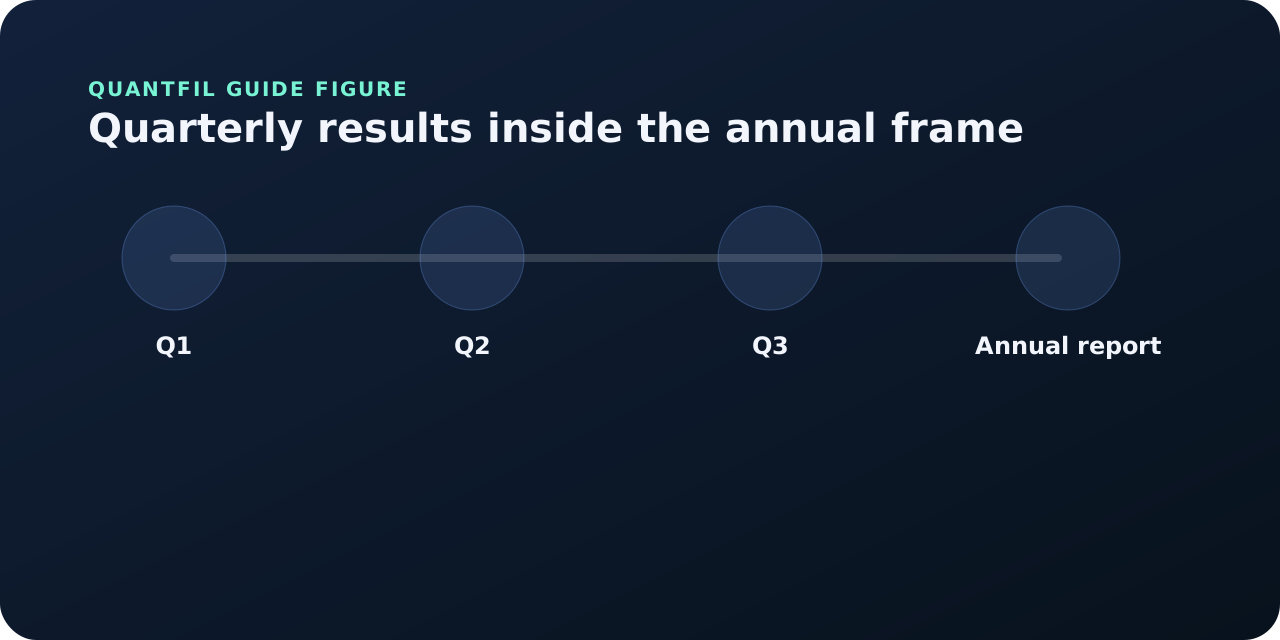
Use the annual filing as context and the quarterly filing as change detection. The better insight often comes from the relationship between them instead of from either one alone.
- Read the quarter on its own.
- Pull up the annual context and key longer-term metrics.
- Compare what actually changed versus what stayed the same.
- Decide whether the quarter changed the annual story or only the short-term mood.
Common mistakes
The common mistake is treating a quarter as if it rewrote the whole company story instantly. The opposite mistake is ignoring a quarter that really did change the annual read.
Worked example / hypothetical, not company data
Derive the missing fourth quarter
Annual revenue is 900 million and nine-month revenue is 650 million on the same accounting basis.
What can you infer about the fourth quarter?
Derived fourth-quarter revenue is 250 million. It is not necessarily one fourth of annual revenue. Compare it with a similarly derived prior-year fourth quarter and check for restatements or fiscal-week differences. A fourth quarter derived by subtraction inherits any inconsistency between the two source totals.
Source check: Label the amount 'derived Q4' and keep both annual and nine-month sources next to it.
Choose a company source
These reference pages link to dated filings. Apply the question to the document, rather than treating the reference data as an analyst opinion.
Frequently asked questions
Why compare a quarter with the annual report?
Because a quarter can feel more important than it really is without longer-term context.
Can one quarter still change the annual picture?
Yes. Some quarters genuinely shift the business read, which is exactly why the comparison matters.
What is the main trap here?
Confusing seasonality or timing with a lasting change in earnings quality or business momentum.
Primary sources and further reading
Use and provenance
Educational analysis, not investment advice. The worked exercise is hypothetical, not a company disclosure. Use the primary sources above for definitions and the exact filing for company-specific facts. Publishing and accountability · Report a correction.