
A useful red flag is not just a scary phrase. It is a repeatable signal that changes how much trust you place in the narrative, the statements, or the next quarter's setup. This library is meant to help investors recognize those signals faster and ask a better follow-up question when they appear. Investors often talk about red flags as if they are intuitive. In practice, they become more useful when they are structured and repeatable.
This matters because a red flag should change behavior. It should tell you where to slow down, what to compare, and what the next report now needs to resolve. The goal is not to read more words than necessary. It is to read the right part of the filing in the right order.
- A red flag is useful only if it changes the next question you ask.
- Most red flags live in changed wording, mismatched statements, or note-level detail.
- The strongest red-flag habit is comparison, not intuition alone.
Why this matters
This matters because a red flag should change behavior. It should tell you where to slow down, what to compare, and what the next report now needs to resolve.
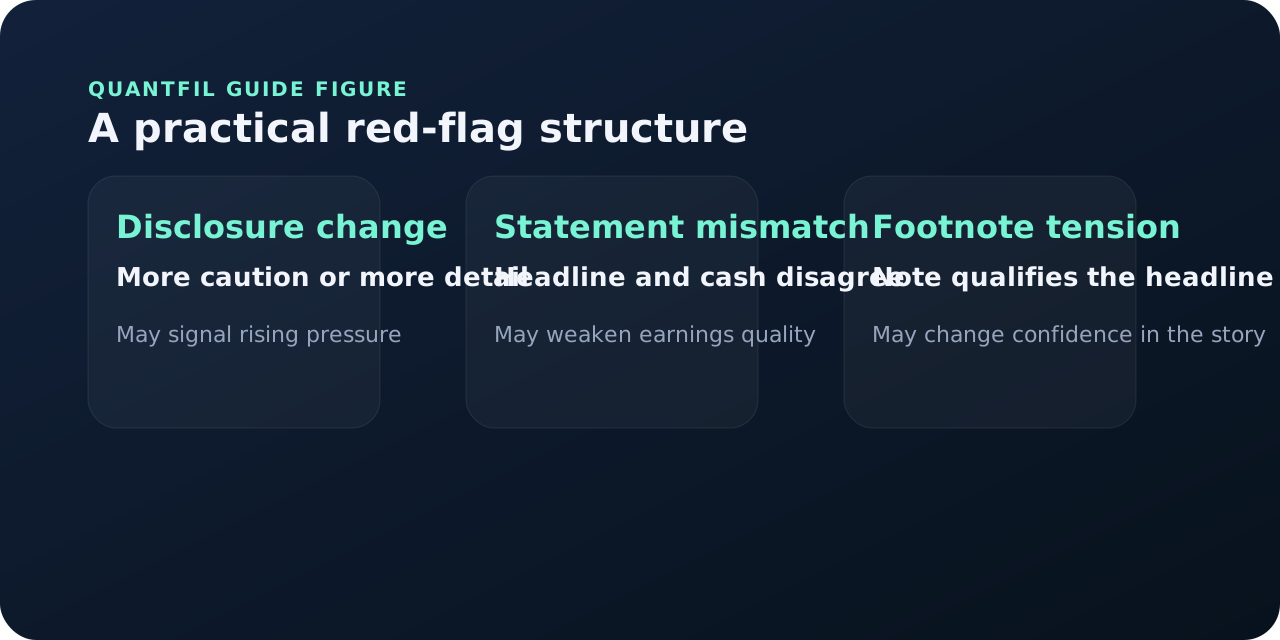
Look for recurring categories such as changed risk language, weak cash conversion, rising dilution, working-capital stress, unusual non-GAAP reliance, or footnotes that carry the real tension of the period.
What to look for
Look for recurring categories such as changed risk language, weak cash conversion, rising dilution, working-capital stress, unusual non-GAAP reliance, or footnotes that carry the real tension of the period.
Use the red flag as a routing tool. Once you spot it, decide whether the next step is the prior filing, the cash-flow statement, the footnote, the earnings call, or the next quarter.
- Identify the red flag category.
- Locate where it appears in the filing.
- Compare it with the prior filing or with another statement section.
- Write down what the next report would need to show before confidence improves.
A practical workflow
Use the red flag as a routing tool. Once you spot it, decide whether the next step is the prior filing, the cash-flow statement, the footnote, the earnings call, or the next quarter.
That workflow becomes easier to repeat when you write the next question down before moving on. The filing should not just be read. It should leave you with a sharper question than you had at the start.
Common mistakes
The common mistake is labeling something a red flag without tying it to a follow-up action. A useful red flag should immediately tell you what to verify next.
A slower, more selective filing habit usually beats a faster but less structured one. In most cases the difference comes from knowing what you are trying to prove before you go hunting through the document.
How to use this on Quantfil
Quantfil is useful here because it can move the reader straight from the signal to the supporting filing page, statement view, or comparison work that clarifies it.
Quantfil is most useful when the educational question comes first and the company page comes second. Learn the document, then use the filing page to apply that reading habit to a real report.
Ask yourself
Try it on Quantfil
Move from the educational overview into live filing pages that show summaries, comparison cards, and source-linked context.
Try the next workflow
Use one of these next-step pages if you want to turn the concept into a repeatable habit on a live filing, earnings setup, or company comparison task.
Frequently asked questions
Is every red flag thesis-breaking?
No. Some signals are warnings, not conclusions. The point is to slow down and verify.
What makes a red flag more important?
A red flag becomes more important when it is new, more specific, or supported by another weak signal elsewhere in the filing.
Why build a library instead of just reacting case by case?
Because repeatable signals make future filing reads faster and steadier.
How does Quantfil help?
It helps you move directly from the signal to the most relevant filing page or comparison path.
Primary sources and further reading
Editorial note and disclosure
Quantfil publishes these guides for informational purposes only. They are designed to help readers understand filing structure, investor workflow, and source verification, not to offer investment advice or security recommendations.
If a guide looks stale, unclear, or incomplete, use the source links above and review our editorial standards, corrections policy, and editorial team page for how the site handles updates and accountability.