
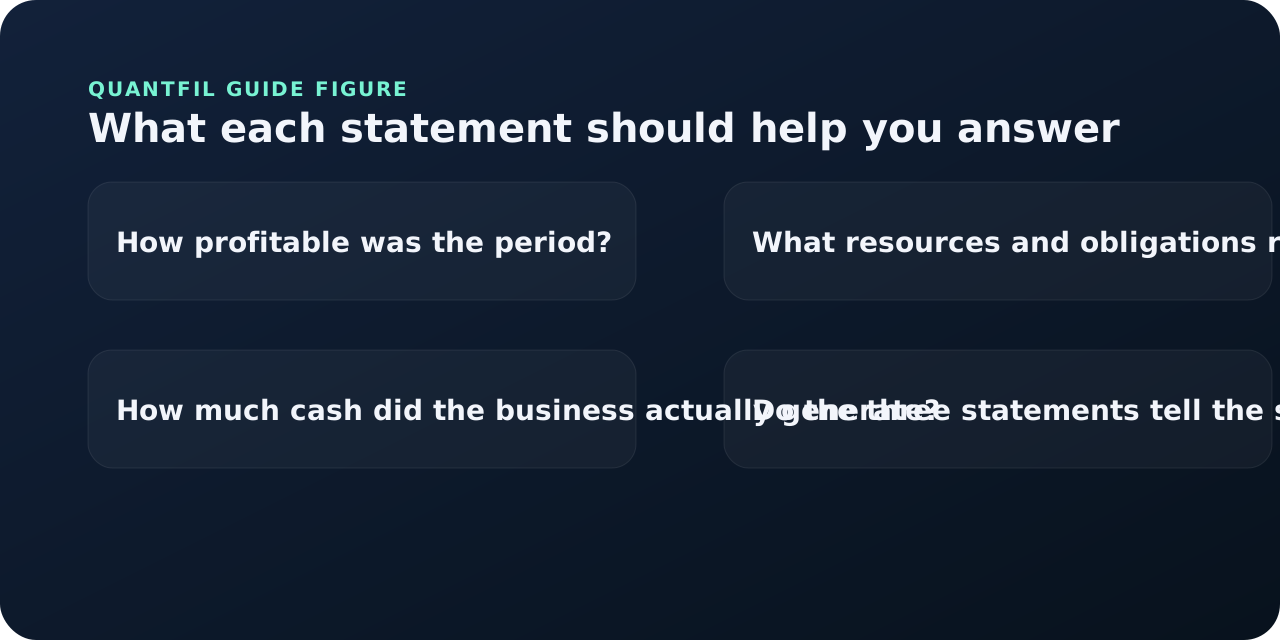
The three main financial statements are most useful when they are read together. A filing becomes clearer once you stop treating each statement as a separate task. A filing can feel far more readable once the statements are treated as a linked system instead of three unrelated tables. That habit improves both speed and judgment.
Investors often over-read the income statement and under-read the balance sheet and cash flow statement. That makes it easier to mistake an accounting improvement for a durable business improvement. The goal is not to read more words than necessary. It is to read the right part of the filing in the right order.
- The statements should be read together, not one at a time.
- Cash flow is often the best test of whether earnings quality is improving.
- The balance sheet can quietly change the risk profile even when the income statement looks strong.
Why this matters
Investors often over-read the income statement and under-read the balance sheet and cash flow statement. That makes it easier to mistake an accounting improvement for a durable business improvement.
Start by asking whether profitability, liquidity, and cash generation line up. If revenue and net income improve but working capital deteriorates or operating cash flow weakens, the filing may be telling a more mixed story than the headline suggests.
What to look for
Start by asking whether profitability, liquidity, and cash generation line up. If revenue and net income improve but working capital deteriorates or operating cash flow weakens, the filing may be telling a more mixed story than the headline suggests.
Read the income statement for operating direction, the balance sheet for financial position, and the cash flow statement for proof of earnings quality. Then compare the three before deciding what the period means.
- Read the income statement for direction.
- Check the balance sheet for position and pressure points.
- Use the cash flow statement to validate the earnings story.
- Compare all three before deciding what changed.
A practical workflow
Read the income statement for operating direction, the balance sheet for financial position, and the cash flow statement for proof of earnings quality. Then compare the three before deciding what the period means.
That workflow becomes easier to repeat when you write the next question down before moving on. The filing should not just be read. It should leave you with a sharper question than you had at the start.
Common mistakes
A common mistake is treating each statement as a self-contained chapter. The better habit is to read them as a conversation about the same period and the same business.
A slower, more selective filing habit usually beats a faster but less structured one. In most cases the difference comes from knowing what you are trying to prove before you go hunting through the document.
How to use this on Quantfil
Quantfil is most helpful here when the filing summary pushes you toward the right statement first, then the metrics and visuals let you test whether the broader story is actually consistent.
Quantfil is most useful when the educational question comes first and the company page comes second. Learn the document, then use the filing page to apply that reading habit to a real report.
Try it on Quantfil
Move from the educational overview into live filing pages that show summaries, comparison cards, and source-linked context.
Frequently asked questions
Which statement should I read first?
Many readers start with the income statement, but the best answer is whichever statement helps you understand the main question of the filing fastest.
Can a company report stronger earnings while becoming riskier?
Yes. Balance-sheet pressure or weak cash conversion can change the risk profile even when earnings improve.
Why is cash flow so important?
Because it helps you see whether the business is actually turning reported performance into cash.
Does Quantfil replace the statements?
No. It is meant to make the first pass more efficient and point you toward the sections worth verifying in the source filing.
Primary sources and further reading
Editorial note and disclosure
Quantfil publishes these guides for informational purposes only. They are designed to help readers understand filing structure, investor workflow, and source verification, not to offer investment advice or security recommendations.
If a guide looks stale, unclear, or incomplete, use the source links above and review our editorial standards, corrections policy, and editorial team page for how the site handles updates and accountability.